Journalist, advocate, policy adviser? My strange role in the fight against superbugs
Misbah Khan on how she helped inform UN plans to tackle a growing global threat

At the end of April, I found myself at a conference room in a Lagos hotel, surrounded by scientists and researchers from around the world, all gathered to address one of our most pressing global health threats: antimicrobial resistance (AMR).
In my two years reporting on AMR, I’ve attended a few of these events. But for the first time, I wasn’t there as a journalist. Over the previous three months, I had been working for a thinktank. Last year, the UN announced it would be setting up an independent panel on AMR. My job had been to help draft a policy paper exploring how that panel can turn evidence into international action.
As a journalist, my reporting on AMR has taken me across the world, from Ethiopian hospital wards to the offices of Pakistan’s health ministry. I’ve interviewed countless patients suffering from infections that have evolved faster than medical science can develop drugs to treat them, as well as the doctors and nurses on the front lines of this global health emergency.
Sitting in that conference room, I felt the responsibility to act as a conduit for those patients’ experiences, knowing that my words could inform important decisions made by powerful people. I was no longer a fly on the wall, but an active participant in the global efforts to fight AMR. Where had I got the gall?
There is a certain understanding that comes from having been on the ground in multiple countries, hearing firsthand accounts, and witnessing how systems fail people. But this opportunity to put the expertise into action meant crossing the line from reporting to advocacy, which can be an uncomfortable experience for a journalist.
But the Bureau of Investigative Journalism (TBIJ) is an impact-driven organisation. We don’t produce investigations for their own sake but to drive real-world change, to bring our reporting to the attention of those with the power to act. Here was a unique chance to do exactly that.
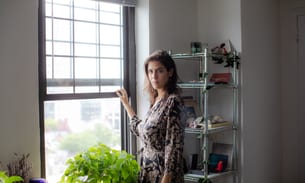
 Misbah Khan (second left) at the World Health Assembly in Geneva.
Zuzanna Mieloch, Center for Global Development
Misbah Khan (second left) at the World Health Assembly in Geneva.
Zuzanna Mieloch, Center for Global Development
TBIJ has been reporting on AMR for nearly a decade, and now it seems people in power are ready to listen. Last year, at the United Nations General Assembly, every UN member state signed a declaration committing to action on AMR, underlining its status as a cross-border threat to human and animal health. The panel is borne from that agreement. It will be made up of AMR experts and tasked with providing evidence to member states on how to combat the crisis.
The formation of this panel is a mammoth task, and the questions it raises animated the discussions in Lagos: What will this panel actually do? Who should be on it? How can it truly make a difference?
Behind each of these questions lies a tangle of political sensitivities, institutional power dynamics and deep-seated inequities – particularly for countries with lower resources that often bear the brunt of AMR but have the least say in shaping global health agendas.
The legacy of colonialism looms large in any discussion of global health and felt particularly pertinent at the conference in Lagos, with various health services under threat as western countries cut their foreign aid budgets.
Experts from around the world, including Nigeria, Uganda, Brazil and Singapore, were in attendance, brainstorming ways to avoid past mistakes and advocating for representation that was not simply a checkbox exercise. They demanded a seat at the table with real influence, clear accountability and a commitment to translating science into practical solutions.
The Bureau newsletter
Subscribe to the Bureau newsletter, and hear when our next story breaks.
The aim of the paper was to inform the UN agency representatives in attendance how the new panel could learn from existing ones – and what it could do better.
In delivering the paper, I drew on the network I have developed over years of reporting. I wanted the attendees to understand that this is not a theoretical exercise – and that there is no one-size-fits-all solution to this crisis. And so our paper was grounded in the lived realities of those most affected: people who know how the needs of a rural clinic without stable electricity differ from those of a private hospital ward.
I hope that their insights, gathered through my reporting and relayed in that conference room in Lagos, landed with the people setting up this panel. It’s a project that could finally deliver meaningful global action against one of our most urgent health threats.
Lead image: DFID/ Will Crowne via Flickr
Reporter: Misbah Khan
Deputy editor: Chrissie Giles
Production editor: Sasha Baker
TBIJ has a number of funders, a full list of which can be found here. None of our funders have any influence over editorial decisions or output.
-
Subject:
-
Area: