Karen Hao on AI: ‘No one is asking whether this tech is actually helping people’

When Pope Leo XIV published his Encyclical Letter “on safeguarding the human person in the time of artificial intelligence” on Monday, my first thought was “He’s read Karen Hao’s book, hasn’t he?”
The book in question, Empire of AI, came out last year and covers many of the most urgent tech issues of today: the gig workers stuck in exploitative and traumatising jobs; the soaring environmental harm done by data centres; the egomania of industry leaders like Sam Altman; and the symbiotic relationship between these figures and Donald Trump.
If that feels like a lot, Hao has both the linguistic and moral clarity to make it all fit together. Hao is able to step back far enough to see the AI story in its full context. And a large part of that context, as the title suggests, is the historic global power imbalances that separate the rich from the poor.




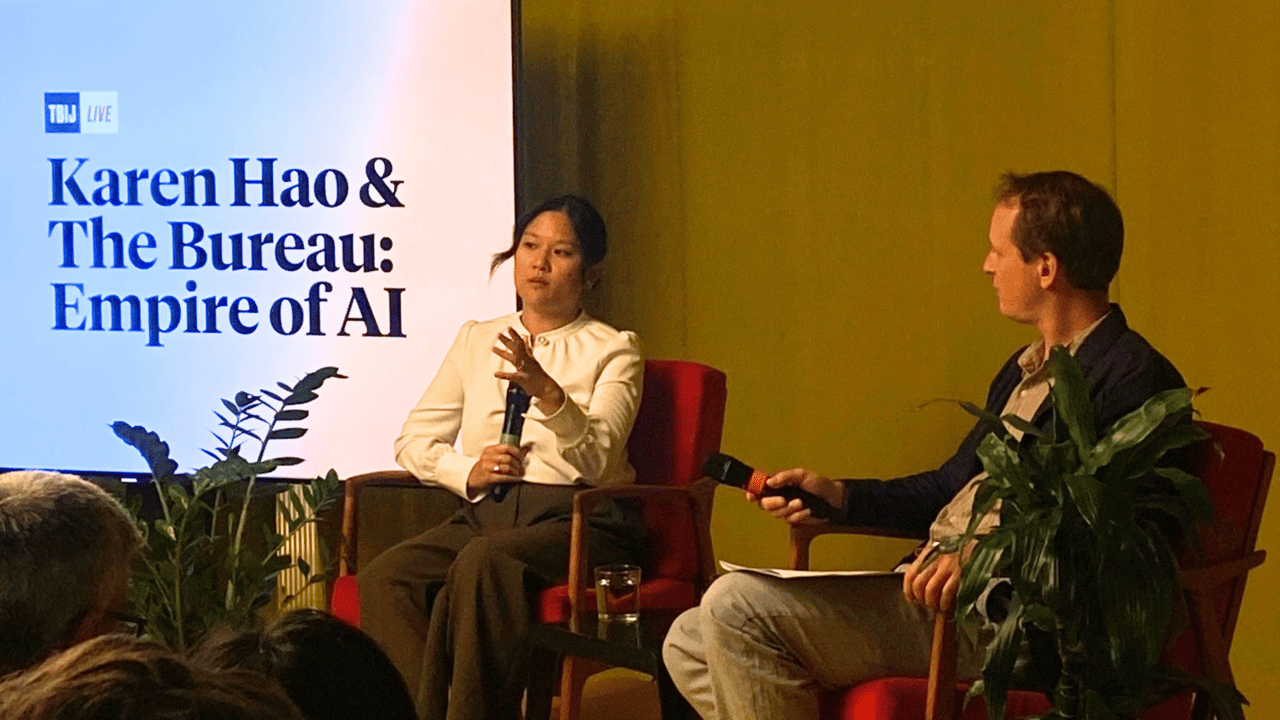
On Wednesday evening I sat down with Hao at Second Home in Spitalfields, east London, for a conversation about her book. And given that, a day earlier, the Pope had described the global AI industry as “colonialism assuming a new form” in a forceful critique of the industry, I thought I’d better ask her about it. This was her answer:
For such a long time we just didn’t have a stance from anyone as influential as the Pope himself articulating the question of: Is this technology, as it is being built today, helping people? It’s such an important stake in the ground right now at a time when everything else is fixated on the efficiency and productivity and military capability that AI provides. What Pope Leo is trying to remind us is that at the end of the day no technological progress matters unless it is actually leading to human and social progress.
That final point is made throughout Hao’s book. Many of her discoveries come from talking to the people whose labour benefits the giant AI companies but who enjoy none of the spoils. These are people doing painstaking and often traumatising work for little pay: sifting through offensive material that must be kept off tech platforms, or building the datasets that help computers “learn” a human language.
Before embarking on the project she had read various academic studies that drew parallels between the tech industry and colonial empires. But she wanted to know whether this theory would hold up when she spoke to people most exploited by the industry.
We don’t have to accept the corrosive supply chain currently used to produce AI. We could get the same technologies in other ways
“The thing that shocked me most was that they were first to use that language with me,” Hao said. “I wouldn’t necessarily ask, ‘Do you feel like you’re part of a colonial world order?’ They would tell me that this is part of a fight we’ve been fighting for centuries. We are the descendants of ancestors engaged in the same exact fight, just with different faces.”
At the other end of the scale, Hao believes the current pact between Trump and his clique of AI billionaires isn’t as strong as it appears. “People see this fusion of state and tech power, and they think it's terrifying and it looks kind of unstoppable,” she said. “But the thing about empire is that you want to be the supreme power in the world – and there can only be one.” She pointed to the president’s rapid fallout with Elon Musk as an example of the fact that “while they currently have this happy romance, it’s going to turn really bad”.
But there is hope to be had, she said, in the community-level resistance to destructive processes – industrial-scale land acquisition, vast water consumption – driving the quest for the ever-more powerful chatbots.
“We don’t have to accept the corrosive supply chain that is currently being used to produce this version of AI,” Hao said. “We could actually get the very same technologies with significantly lighter-weight supply chains.”
She also expounded on the positive, inspiring uses of AI: for scientific discovery, for mitigation of the climate crisis, and for keeping alive vanishing Indigenous languages.
Hao answered a whole range of questions, finishing on one from a woman who described herself as seeing AI chatbots in the same way as she does chocolate: both desiring it and trying desperately to avoid it.
Hao compared the challenge to taking on the clothes industry. You don’t change the industry by going without clothes but by organising with labour unions, engaging in consumer pushback and pushing for government regulation.
“We need to do the same thing now,” Hao said. “Don’t just think of yourself as a consumer who can only either eat chocolate or diet. Think of yourself as someone with various different ways of intersecting with AI supply chains. All the data centre protesters are wearing the hat of land defenders and water defenders. Artists and writers are using litigation to challenge the intellectual property question. Parents are suing the companies to challenge the psychological harm to their kids. That has become a lever by which to limit the empire.
“You can have your chocolate and also not be abetting what you are against.”
-
Area:
-
Subject: