Fossil fuels aren’t just ruining the planet, they’re risking our pensions
The conflict in Iran has shown up gas and oil as unsafe investments. It’s time our pensions left them behind

The final few oil tankers to cross the Strait of Hormuz before the start of Trump’s war in Iran only reached their destinations last week. That means the global economy is yet to feel the full force of an operation that has blocked 20% of the planet’s petrol and liquefied natural gas (LNG) supplies.
What could that end up looking like? Well, the Economist reports that already in Asia, seven countries have forced people to work from home and at least five are rationing fuel. And given the huge amounts of fuel needed by the agriculture industry, the Strait’s continued closure will soon turn this energy crisis into a food crisis.
As tankers stuck behind the blockade sail in circles around the Gulf, companies that can still ship fuel around the world – notably those from the US – are reaping the profits. But in the long term, this conflict may have delivered a damaging reputational blow to the industry worldwide. LNG in particular has been promoted as a cheap and reliable energy source. Yet right now, supplies have been cut off and prices are rocketing.
This has focused the minds of politicians on how secure our energy supplies really are, with many looking to renewables. As veteran climate campaigner Bill McKibben put it: “Sunlight travels 93 million miles to reach the earth. None of them through the Strait of Hormuz.”


The recent growth in renewables and battery storage – to cover the times when there’s no sun or wind – has already been staggering. Last year, more than 900GW of renewables and battery capacity was added around the world. To put that in context, the total energy being drawn from the UK’s National Grid at lunchtime yesterday was about 30GW.
“This isn’t a transition,” says Assaad Razzouk, chief executive of Gurīn Energy, a renewable energy company. “It’s a hostile takeover by superior economics. Betting on fossil fuels today is exactly like betting on whale oil while Edison was turning on the lightbulb.”
And yet our pension funds continue to do just that. Last week, we revealed that 60 local government pension funds have invested a total of £8bn into infrastructure funds paying for the rapid construction of LNG export terminals in the US, and other oil and gas assets.
Savers in Bedfordshire, Cumbria, Durham, East Riding, North Yorkshire, Surrey, South Yorkshire, Teesside, Tyne and Wear, Warwickshire and Worcestershire are unwittingly supporting a company called Seapeak, which operates LNG tankers. One of them is currently doing laps of the Persian Gulf.
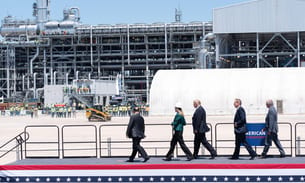
The same funds have helped pay for a new LNG terminal in Louisiana, which is still being built and isn’t expected to export gas until 2029. Who knows how popular LNG will be by then.
As the fossil fuel economy grows more volatile, any money invested in oil and gas is put at risk. And as the world switches away from fossil fuels, that risk will become terminal.
That financial danger extends to pension funds’ other investments whose value could be hit by the impact of climate change. The Institute and Faculty of Actuaries, a chartered professional body, forecasts that the global economy could face a 50% loss in GDP between 2070 and 2090 unless immediate policy action is taken on climate risks. That kind of hit will cause an earthquake in financial markets – and pension fund portfolios will not be immune.
Pension funds are the ultimate long-term investment: we save today in order to retire in several decades’ time. And so it’s vital that money is invested responsibly. UK pension funds control over £3 trillion worth of assets – enough financial clout to insist their investments do not support fossil fuels. They owe it to their members to do so.
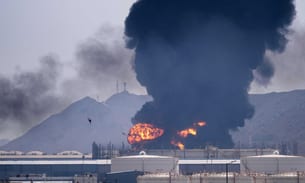
Header image: Smoke rises from a major UAE energy installation after a strike targeting the Gulf's petroleum facilities last month. Credit: AFP via Getty
Reporter: Josephine Moulds
Environment editor: Rob Soutar
Deputy Editor: Chrissie Giles
Editor: Franz Wild
Production Editor: Alex Hess
The Bureau has a number of funders, a full list of which can be found here. None of our funders have any influence over editorial decisions or output.
-
Subject:
-
Area: