Racist riots in Belfast recall the darkest days of the Troubles
Masked thugs burning the homes of ‘foreigners’ is part of a long history of racist violence in Northern Ireland
The message circulating on WhatsApp listed 26 locations in and around Belfast with an unambiguous instruction: “Forward to all men of the age 18 and over. Wear dark clothing… and be prepared to fight or be arrested.”
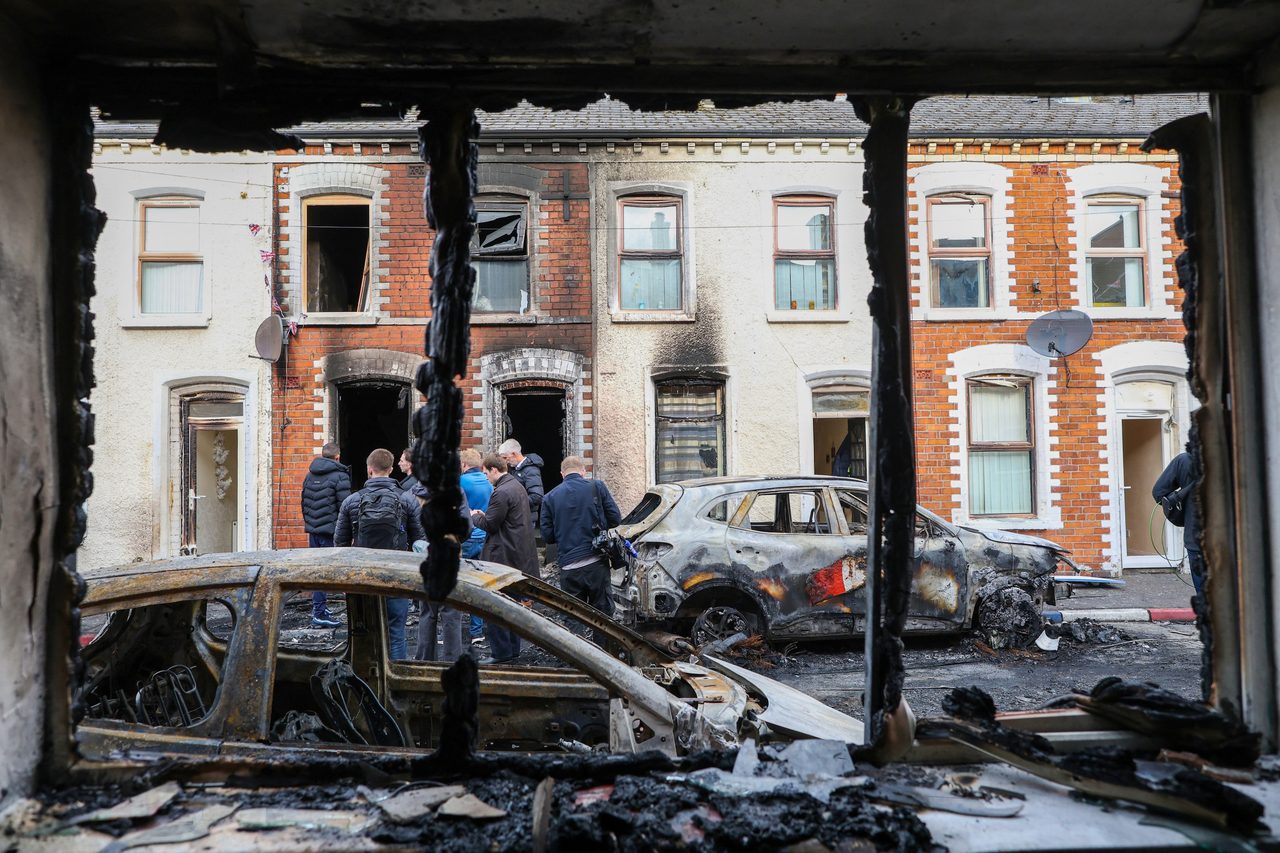
On Tuesday night, hundreds of masked men heeded its call. They set fire to homes and cars, kicked in doors and broke windows, while shouting “get foreigners out”. The fire brigade attended 62 incidents across the city.
On Wednesday morning, with debris from the night of violence littering the streets, fresh rumours and threats spread through the city on social media. “All businesses to close at 11am – no exceptions”, read the anonymous online instructions. In response, shops, gyms, cafes, cinemas and pubs shut their doors.
Around a dozen schools across Belfast and the outskirts, including my daughter’s, contacted parents to ask them to pick their children up within the hour so teachers could travel home before 1pm.
The first night of violence had seen a Glider bus torched at the bottom of Newtownards Road in east Belfast. The following day, public transport was suspended at 5.30pm. The city was effectively on lockdown.
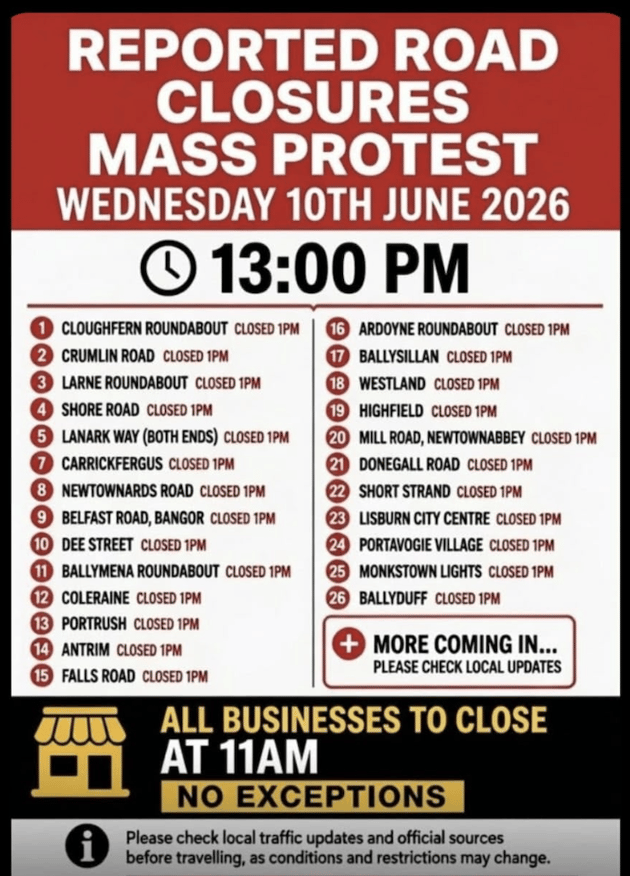 Anonymous instructions shared on social media warning businesses to close
When Wednesday evening finally arrived, rioters targeted a hotel being used as asylum accommodation in Glengormley, on the outskirts of the city. Cars were burned and petrol bombs were thrown at police. Water cannons were used to disperse the crowd and 12 officers were injured. But the widespread violence that many had feared – and which was called for on social media – did not materialise. There was no disorder at most of the 26 locations named in the WhatsApp warning.
The events in Belfast – sparked by an alleged knife attack by a Sudanese refugee on Monday – have shocked many outside observers, but racist violence itself is nothing new for the city’s residents.
Patrick Corrigan, head of nations and regions at Amnesty International UK, points out that this is the third consecutive summer of organised racist violence in Belfast: an annual swell of anger ahead of the Orange Order’s marching season in July.
“Each outbreak is more serious than the last,” he said. “Race hate crime in Northern Ireland was already at record levels before these attacks, with more than 1,500 in the last year. Hundreds more were committed over the past two nights, including families forced from their homes by petrol-bomb wielding mobs”.
This week’s violence took place in traditionally loyalist parts of Belfast: areas permanently festooned with union flags, and others supporting the loyalist gangs of the Troubles. They’re also among the more affordable areas of Belfast, and home to large numbers of immigrants and ethnic minorities. But some of them can be intimidating: imagine living in the middle of a permanent BNP rally – and you get the idea.
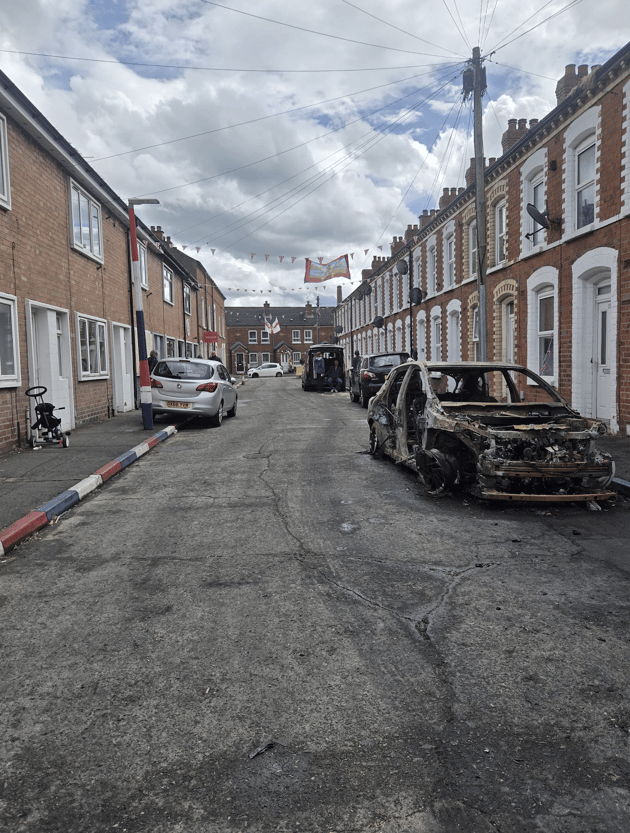 Arson attacks on cars and homes forced families from their homes
Lara Whyte
Arson attacks on cars and homes forced families from their homes
Lara Whyte
The clean-up transformed the city almost as swiftly as the violence had. By Wednesday afternoon, the area at the centre of Tuesday’s riots was calm and rain-soaked.
A smattering of kids dressed in black mooched around, speaking to journalists or filming content next to burnt out cars. Vehicles filled with men rolled past slowly and locals kept their heads down.
A woman this morning who has recently fled a warzone told me she is more terrified today than she was then.
A volunteer delivered food parcels to families too afraid to leave a nearby house. She spoke to me on the condition of anonymity, criticising the police for being too slow to respond to what had happened.
“A woman this morning who has recently fled a warzone told me she is more terrified today than she was then,” she said. “She is alone: a single mother with two children. Their house was set alight and police took 20 minutes to come, so they had to stay inside until then. They could have died.”
The volunteer told me she planned to flee Belfast that evening, over fears for her own children.
“Like me, the women I spoke to say they are devastated. And they want to help each other, but then some also don’t want to leave their house.” she said. “There is worry, and there is fear and that fear is fresh, as it's the first time many have experienced this level of violence in their area.”
A 56-year-old mother of two who moved to Northern Ireland in 2008 described her anger and fear. “It’s a scary time to be an immigrant,” she said. “I am not leaving my house and neither is my son. Seeing the damage from last night is crazy and we all – including working immigrants – have to pay for this out of our pockets.”
Families being forced out of their homes by masked men in the middle of the night is not new in Belfast. These types of attacks have been part of the playbook of loyalist paramilitaries, like the Ulster Volunteer Force and the Ulster Defence Association, for decades. There is an ugly history of Catholics’ homes being burned during the darkest days of the Troubles.
Seamus de Faoite, a Social Democratic and Labour councillor, believes this historical context is difficult to ignore. He spoke to me while helping with relief efforts.
“There are at least 50–100 families who had to move overnight because their homes have been attacked overnight, and it is just disgraceful,” he said.
“We have kids standing outside in the rain in the middle of the night, because someone has decided because of their skin colour they deserve to be attacked.”
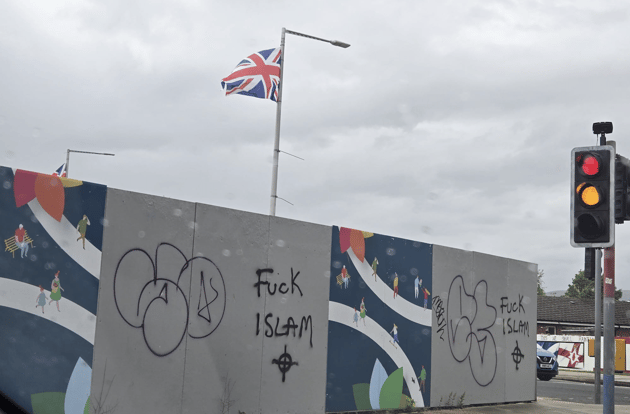 Islamophobic graffiti appeared around the city
Lara Whyte
Islamophobic graffiti appeared around the city
Lara Whyte
When I was a baby – over 40 years ago – my father’s family was bombed out of their home in south Belfast. My grandmother was killed in the attack. Similarly, De Faoite’s father’s family were forced to relocate from what is now a Protestant enclave in the Shankill in west Belfast.
Back then, people were targeted for being in mixed marriages between Catholics and Protestants. Now it’s for the colour of their skin.
De Faoite was scathing in his condemnation of the role played by outside actors with no stake in Northern Ireland. “I wonder whether Elon Musk would be able to point out Belfast on a map – or similarly, Nigel Farage and others who have been whipping this up. They all need to butt out of Belfast.”
While external actors should be held responsible for fomenting violence, the riots would not have happened without the tacit or direct support of loyalist paramilitary groups. And as racist incidents rise, some of their old intimidation tactics are reemerging.
Historically, loyalist and republican paramilitaries in Northern Ireland used extortion rackets to fund their activities. De Faoite says loyalist gangs are now shaking down immigrant-owned businesses with threats of violence.
I wonder whether Elon Musk would be able to point out Belfast on a map – or similarly, Nigel Farage and others who have been whipping this up. They all need to butt out of Belfast.
“It really points to how far we have yet to go in terms of actually getting rid of paramilitaries. It is long past time for them to exit the stage,” he added.
Whether this will happen remains unclear, but the first step must be to speak accurately about what is happening in these communities.
The violence in Belfast and further afield is not how it appears on screen, and it’s overly simplistic to blame outside online actors. Clearly social media has an organising and amplifying role, and emotions are being boiled, but that isn’t the only thing going on.
On Wednesday, no one was willing to take the chance that the violence threatened online would not materialise, because we all know what loyalist paramilitaries can be capable of.
We are traumatised by this knowledge, by our parents’ experiences – and now we are forced to watch the consequence-free reign these gangs seem to enjoy as they terrorise our minority ethnic neighbours with these ugly old methods.
Without acknowledgement of paramilitary involvement, it’s impossible to begin to understand how to stop these shameful new pogroms, the recreational rioting, or the besieging of a whole city living alongside their unending threat.
Lead image: Burnt out homes in Belfast this week. Credit: Paul Faith for AFP via Getty Images
Reporter: Lara Whyte
Bureau Local editor: Gareth Davies
Production editor: Sasha Baker
Deputy editor: Katie Mark
The Bureau has a number of funders, a full list of which can be found here. None of our funders have any influence over editorial decisions or output.
-
Subject:
-
Area: