Local media needs to do better on its immigration reporting
A story published by Reach's regional outlets last week showcased the human cost of cheap clickbait

When we talk about how the UK media reports on immigration – and how that shapes public opinion – we tend to talk about the national press.
On the one hand this makes sense. There’s no doubt the decades-long anti-migration stance of the Mail, Telegraph, Express and Sun has had a profound effect. And while newspaper sales are now falling, the websites of those four titles still attract 70 million readers between them every month. All of those readers are subjected to an overwhelmingly negative portrayal of migrants.
Yet millions of people also visit local news sites, and these outlets are often the first to report on the issues at the heart of the public discourse on immigration: housing, crime, local services. In this sense, local media coverage warrants a lot more attention than it gets.
Take, for example, a recent story published by Reach – the largest local news organisation in the UK, with more than 100 outlets including the Liverpool Echo, Manchester Evening News and the South Wales Evening Post.
Last week Reach’s central data team produced an interactive map, with accompanying text, based on migration data published by the Office for National Statistics. The way this was then published by its various regional sites offers a stark insight into the conflicting ways the media can report the same information, even from within a single company.
Belfast Live initially published the story on Sunday alongside the headline: “Interactive map details how many asylum seekers are living in your area.”
A post on the Belfast Live Facebook page linking to the article, which was behind a paywall, attracted 199 replies – more than is typical – before comments were turned off. Those responses tell their own story.
“What is the point of this post?” asked one reader. “Clicks to bait hate? Cause conflict? Raise tensions?” According to one reader: “The only people who would ever use such an app are racist balloons looking for an excuse to start a ruck. What purpose does it serve other than to bolster rightwing rhetoric?”
Surely enough, the post also attracted more than its share of those “racist balloons”, with asylum-seekers described as “dinghy rats”, “fakeugees” and “vermin”. Those comments have not been deleted, though the article was taken offline for several days.
When I contacted Belfast Live to ask about the story, editor Sheena McStravick told me the data had been presented “without an agenda, in keeping with our aim to keep readers informed”. It has since been republished.
“We reviewed the article following feedback, found it all to be correct, and have restored it to the website,” she said.
Surrey Live also ran the story, which it headlined: “Interactive map shows number of asylum seekers in Surrey with Ukrainians making up 80%”. The copy itself, which is still accessible on its website, presents the data and map with no context, analysis or comment. “The number of asylum seekers living in Surrey has increased,” reads the opening line. It is illustrated with a picture of a Border Force patrol boat.
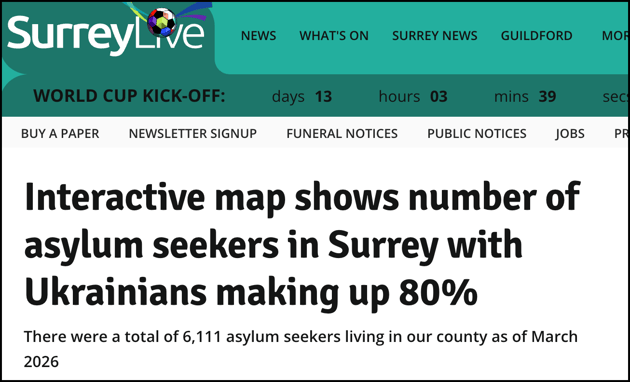
On Surrey Live’s Facebook page, several readers criticised the misleading framing, pointing out that the government scheme through which UK residents house people fleeing the Russian war is very different to people entering the country by crossing the Channel.
As one reader put it: “The Ukrainians aren’t asylum seekers, they are refugees. They are two different things.”
The story also inflated the balloons. “Open your eyes,” one reader posted, “Surrey is becoming a third world dump”. “Send them back, all parasites,” spat another. Someone else posted a screengrab of a Spectator article calling for Enoch Powell, the politician infamous for his anti-immigration “Rivers of Blood” speech, to be “uncancelled”.
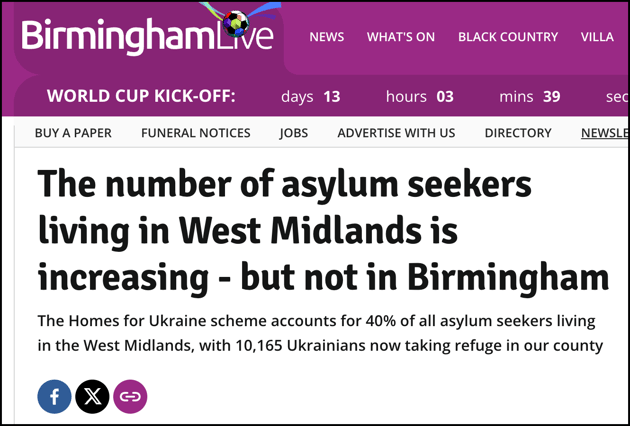
Over on on Birmingham Live, one of the most-read local news sites in the country, the outlet’s version of the story also implied Ukrainians on the housing scheme are asylum seekers. It received similar responses.
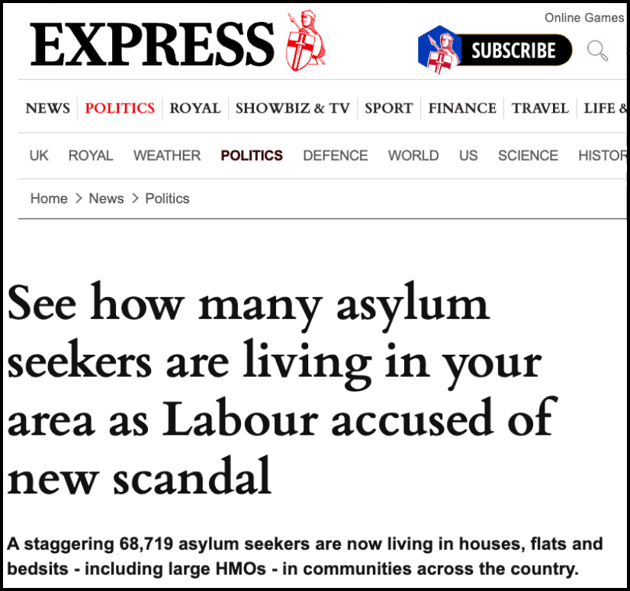
And because Reach also owns the Express, the story also made the national press. This iteration took a more explicitly hostile angle, stating in the headline that readers could “see how many asylum seekers are living in your areas as Labour accused of new scandal”.
Who was doing the accusing? Conservative shadow home secretary Chris Philp, who used the map as an excuse to state that “many” asylum seekers who are allowed to remain in the country “go on to commit serious crimes”. This oft-repeated claim is not supported by the facts. A 2024 study by the Migration Observatory at the University of Oxford found that foreign nationals are underrepresented in prison populations.
Reach didn’t respond to my questions for this story. But as far as its regional titles go, theirs are far from the only local newspaper Facebook pages being plagued by xenophobic comments. In June last year Northamptonshire Telegraph journalist Kate Cronin took to social media to call out readers commenting on stories involving ethnic minorities. “When someone in a story has black or brown face and you comment ‘deport’ or ‘not British’,” she wrote. That is racist. It’s not the 1970s anymore.”
Twice this year Andrew Topping, an editor at the Newsquest-owned Bury Times, has pleaded with readers to stop posting hateful abuse under its stories. On the latest occasion, last Friday, Topping said the problem had become so bad that some constituents had complained to their local MP.
“Racism, Islamophobia, antisemitism, or any other form of prejudice has no place here,” wrote Topping. “This week alone, we have removed offensive comments, blocked several users, and, where necessary, turned off commenting on certain posts to prevent further abuse. We will continue to do so.”
Both journalists should be applauded for taking a stand. But the problem isn’t just bigoted readers, it’s also the coverage inciting them.
It’s not all bad, and there are examples of superb local reporting about migration. The Bristol Cable devoted an entire edition to the subject to mark a year since the riots in 2024. But there needs to be more of this kind of thoughtful, people-focused journalism. It should also be taken into account that many local newsrooms are shortstaffed and overworked.



Jenni Regan is the chief executive of charity IMIX, which works to improve how migration is covered in the British media. “We see directly how local coverage of immigration shapes community attitudes in ways that national reporting doesn’t always reach,” she said.
“We understand the commercial pressures local outlets are under, and that immigration has become a reliable tool for driving traffic. But when that coverage contains factual inaccuracies and generates comment sections filled with dehumanising language that goes unmoderated, the harm is real. The human cost of that clickbait doesn’t appear in anyone's analytics.”
“Accurate, human-centred coverage of migration exists, and when it appears in local media it can genuinely shift how communities understand their neighbours,” said Regan.
According to a national poll conducted last year, 80% of adults say they trust the news and information they see in their local media. This means local news organisations are in a unique position to counter false and harmful narratives. That opportunity, and people’s trust, should not be squandered for the sake of generating clicks.
Full disclosure: before joining the Bureau almost ten years ago I briefly worked for Reach after it acquired the Croydon Advertiser. I left because I disagreed with its plans for the paper and in doing so I made my misgivings public. Reach has since framed my concerns as a personal crusade against them. That wasn’t true at the time and it isn’t now - I’d be highlighting this example regardless of what company was involved.
Lead image: Demonstrators outside the Bell Hotel, Epping, in October. Photo by Wiktor Szymanowicz / Anadolu via Getty
We want to change the public’s perception of immigration and how the media covers it. To do this we’re launching a long-term project exposing how hate towards migrants is spread, who profits from it and how it affects people and society. Fact-based reporting, supported by statistics like those released by the ONS, will play an important role in our work. But countering harmful narratives also requires positive stories told by people with lived experience of migration. If you want to be a part of this effort, please get in touch at garethdavies@tbij.com.
-
Area:
-
Subject: