
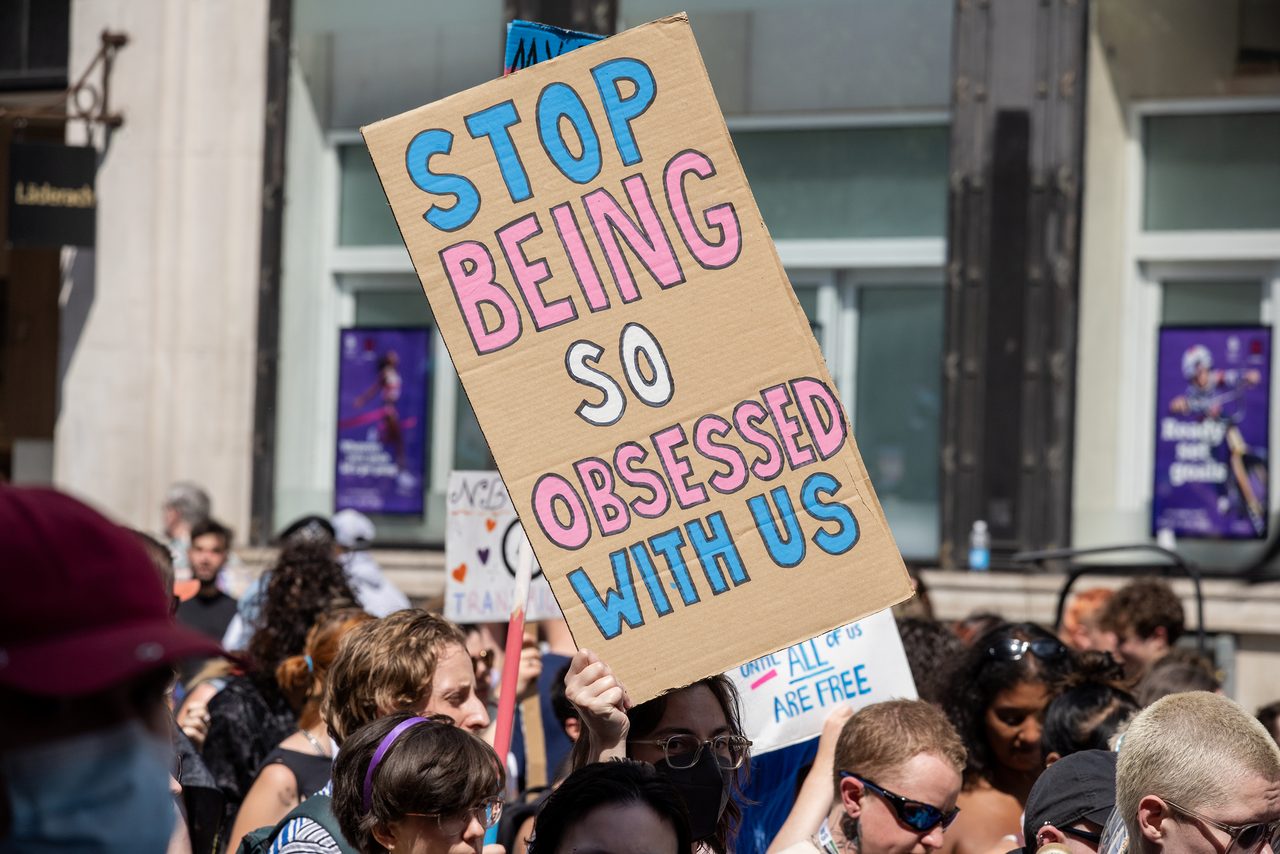
Amnesty International exposed years of anti-trans reporting at four UK newspapers. They ignored it.
Research by human rights group identifies nearly 17,000 articles on trans-related topics in just five years
A young person sits cross-legged at the end of a bed, their head bowed and their arms pressed tightly to the side of their body. A trans pride flag hangs on a wall and a laptop sits open on a desk – the only source of light in a darkened room. On the screen is a news article – transgender people are to be excluded from single sex toilets. Messages from friends about a night at the pub are also visible. “Sorry … I’m not feeling it,” reads the reply, “but you lot enjoy”.
The striking cartoon was published by the Guardian newspaper on 22 May in response to guidance issued by the Equalities and Human Rights Commission (EHRC) that single-sex services, including toilets and changing rooms, have to exclude trans people. The illustration is a powerful acknowledgement of the erosion of trans people’s rights and dignity, and the impact on their mental health.
Yet, a day earlier, the international human rights organisation Amnesty International published research into media coverage of trans issues that paints the attitudes of the Guardian, and three other major UK newspapers, in a very different light.
Analysis commissioned by Amnesty determined that the Times and Sunday Times, the Telegraph, the Sun and the Guardian published a combined 16,913 articles on trans-related topics between January 2020 and April 2025, an average of around nine per day. The Times and Sunday Times had the most with an average of 83.5 articles per month. The report noted the coverage was “entirely disproportionate” to the number of trans people in the UK, who, according to the 2021 Census, make up 0.5% of the population.



Furthermore, the research found that these articles usually excluded trans voices, and coverage was instead “dominated by politicians and anti-trans campaigners”. Across all four newspapers the views of “gender critical” individuals and organisations – who oppose trans-inclusive policies – were “regularly reported uncritically”.
“There is nothing balanced about the way trans people’s lives are reported,” said Chiara Capraro, Amnesty’s gender justice programme director.
“Anti-trans narratives dominate coverage and are often presented as fact, while trans people themselves are pushed to the margins or erased entirely.
“This is not happening organically. What we are seeing is a coordinated and increasingly well-resourced effort to roll back trans people’s rights and reshape public debate. The consequences are real, affecting trans people’s equality, safety and wellbeing across the UK.”
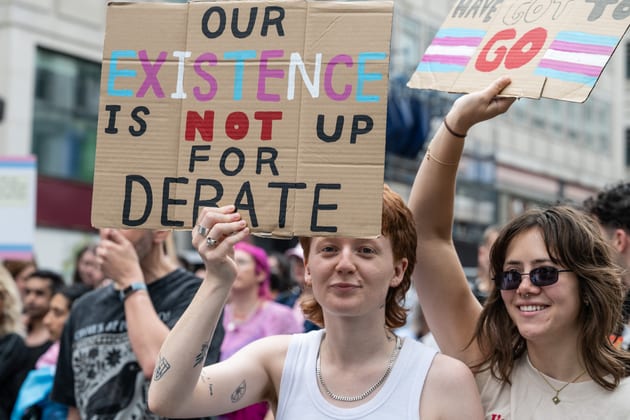 Last year’s Trans+ Pride march in London
Guy Smallman/Getty Images
Last year’s Trans+ Pride march in London
Guy Smallman/Getty Images
Amnesty’s findings will have come as no surprise to the trans community. Pro-trans organisations and campaigners have been raising concerns about disproportionate and unrepresentative media coverage for years. During Trans+ Voices, our community journalism project, this issue was raised consistently.
Even then, the scale of negative coverage Amnesty’s research found is startling: thousands upon thousands of articles about trans issues, many of which question trans people’s fundamental human rights, did not include the voice or perspective of a single trans person. The only British trans people to feature more than eight times were murdered teenager Brianna Ghey and Isla Bryson, a trans woman who, before transitioning, had been convicted of sexual offences.
The anti-trans editorial line across the UK press creates major challenges for trans journalists. In preparing this article I spoke to Eli Cugini, a freelance reporter and PhD student who specialises in writing about trans culture and contemporary literature. During our interview he revealed it was the first time he’d been asked by a journalist to comment on anti-trans issues, despite having reported on it for nearly a decade.
“I am qualified enough that if I was on the other side, if I positioned myself as an anti-trans face on campus, for instance, I would have been deluged with media opportunities,” he said.
“I’m very lucky that I do have some interest in my work … but every commission I’ve gotten in the UK feels like pulling teeth. When it’s related to trans stuff, doubly so.
“When my transness isn’t that much at the forefront then people talk to me like a human being with credentials, but when I talk to people and my transness is more at the forefront I become kind of a nonentity.”
Any UK newsroom which is even vaguely committed to reporting on trans people like they’re human beings can make a real difference
Cugini believes the only way the situation highlighted by Amnesty’s report can improve is if media organisations “really recognise that this is a problem”. “People’s lives and livelihoods are at stake,” he said. “That means any UK newsroom which is even vaguely committed to reporting on trans people like they’re human beings can make a real difference.”
Does the media accept there’s a problem? I looked at how the industry had reacted to Amnesty’s findings. I found they largely hadn’t. The report did get picked up by PinkNews and featured prominently on an episode of Pod Save the UK. Gender critical journalist Janet Murray attacked it in an article published by UnHerd. But the release of the research received no mainstream media coverage at all.
That may, in part, be down to timing. The report launched when the EHRC guidance was dominating the headlines. To be fair to the Guardian – which has previously been criticised by hundreds of staff for its “transphobic content” – the voices of trans people were included in its coverage of the updated code of practice (alongside those of anti-trans campaigners).
In contrast, both the Times and the Telegraph quoted Maya Forstater, chief executive of anti-transgender campaign group Sex Matters, extensively, and neither quoted any trans people or trans rights groups in EHRC ruling coverage.
How did all four newspapers included in Amnesty’s study respond to the report? I contacted the press offices of all four about this story and asked whether they had any comment on Amnesty’s findings. None of them replied.
“It is sadly not surprising,” said Capraro. “The volume of articles produced in five years and the type of language consistently used in relation to trans people show that these are deliberate editorial decisions.”
As Amnesty points out, negative and disproportionate media coverage has real-life implications. Of over 4,000 people surveyed by TransActual, a trans-led research group, 99% said that transphobia in the media affected their mental health.
A TransActual spokesperson said: “When human rights are under attack the role of the press should be to challenge those in power – not cheer them on.
“To wake up every morning to more smears and misinformation about yourself and your community comes with a heavy cost, and has left us facing one of the most significant government-led rollbacks of LGBTQ+ rights in history with a press that has failed in its duty to speak truth to power.
“Amnesty International’s report should be a moment for editors and journalists alike to step back and ask themselves how they ended up supporting a campaign of hate led by some of the most wealthy and powerful people in the world. But, faced with the consequences of the moral panic they built, it seems they have chosen silence.”
Lead image: London Trans Pride 2024.
Credit: Krisztian Elek/ SOPA Images/ LightRocket via Getty Images
Reporter: Gareth Davies
Production editor: Sasha Baker
Fact checker: Lydia Morrish
Deputy editor: Katie Mark
The Bureau has a number of funders, a full list of which can be found here. None of our funders have any influence over editorial decisions or output.
-
Subject:
-
Area:


