How I mapped Britain’s hidden ‘battery cows’
I’ve been reporting on factory-farmed cattle for over a decade. The government may finally be ready to take action
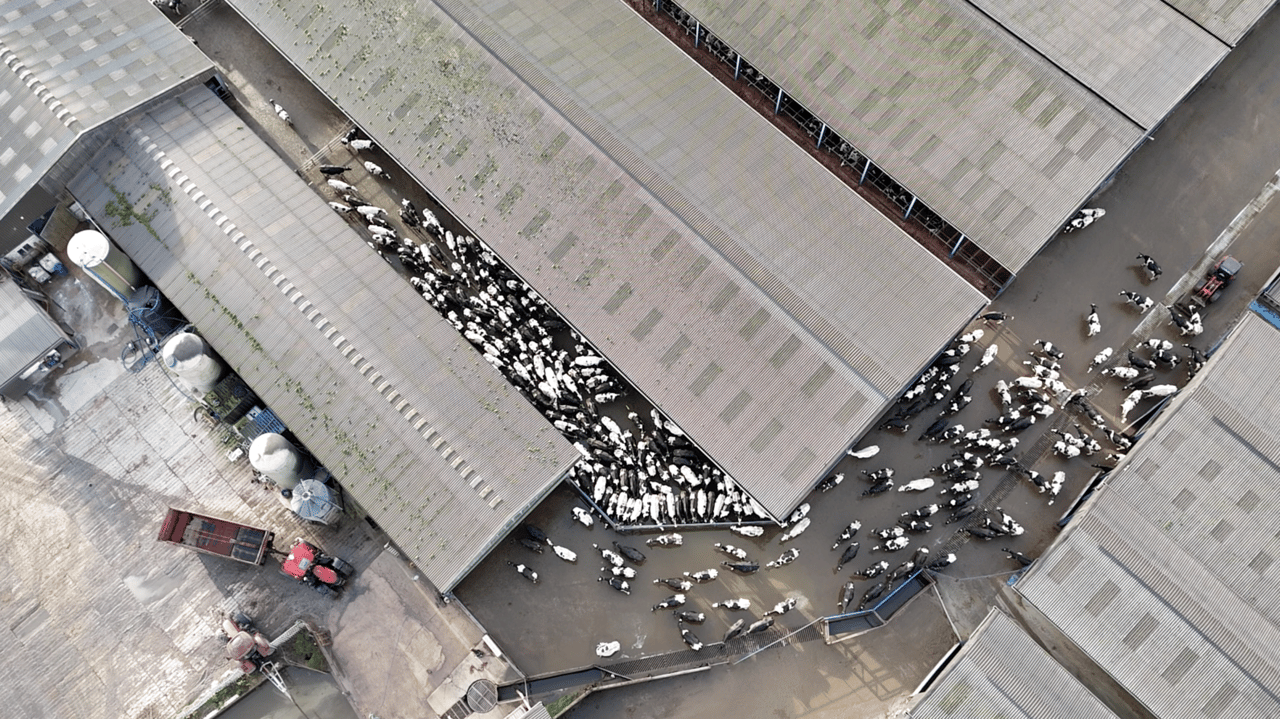
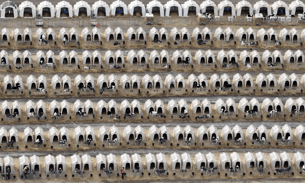
In a quiet corner of the rolling Somerset countryside lies a farm. It is almost completely hidden from public view – a private road leads up to the facility, dominated by several vast steel-framed buildings and conical feed silos. It is an intensive dairy unit, home to at least 1,300 cows which, contrary to the popular image of milk production, do not graze in the fields which surround the farm. Instead, they are confined – all year round - inside a series of huge barns capable of holding up to 400 animals each.
Row upon row of cows are standing or sitting in one of the scores of metal cubicles that run the length of the barns, or wandering around the walkways in between. As there is little or no outdoor grazing permitted, feed and water and everything else the animals need is brought directly to them.
This is how I described a typical UK “mega-dairy” more than a decade ago. Although we like to imagine dairy cows wandering freely in the grass, thousands upon thousands are in fact permanently shut away in barns. So in 2015 I tried to figure out, for the first time, how many of these intensive dairy farms were operating across the country.
No one knew the answer to this – not even the Department for Environment, Food and Rural Affairs (Defra), which is responsible for overseeing farming. A regulatory loophole meant that intensive dairy farmers did not have to hold an environmental permit, making it impossible for Defra to keep tabs on the number or location of these farms.
Remarkably, this controversial loophole still exists. Last year, the government said it would consult on extending the permit scheme to dairy farms and “intensive cattle” units, but further regulation remains a long way off.
When I decided to investigate this issue in 2015, the absence of official data or records made it a daunting task. Thankfully, I had some leads from earlier investigations into so-called “zero-grazing” dairy farms.
Using this as a starting point, a team of colleagues and I set out on the first of many trips, criss-crossing the UK in search of the elusive factory dairies.
After visiting dozens of farms, we had gathered a solid body of information and some powerful images showing the largely unseen scale of the UK’s biggest dairies.
However, it quickly became apparent that visual evidence alone wasn’t enough to prove that cows had no access to pasture. Just because cows were indoors when we visited, it doesn’t mean they never went outside.
So we turned to the industry itself, contacting farmers, unions and people involved in dairy processing. Many were too scared to speak to us, although some agreed to talk off the record.
Having consulted livestock publications, where farmers reluctant to speak to us would often share details of their production systems, we realised that they often used the term “year-round housed” as a euphemism for factory production. So by scouring hundreds of industry news stories and other records, as well as extracting information from interviews, we were able to piece together the first reliable (if small) database of factory dairy farms.
A few years earlier, the arrival of US-style factory dairies in the UK had prompted alarm among campaigners and the public. Plans to build the country’s largest cattle farm in Nocton, Lincolnshire – designed to house some 8,000 animals – were particularly controversial.
When that story was splashed across the front page of the Independent in late 2015, it attracted predictable condemnation from campaigners, and equally predictable criticism from parts of the industry, who said the story was sensationalised. But behind the scenes, some farmers welcomed our reporting. They too had concerns about the industry’s direction of travel. Some of them suspected that we had only scratched the surface.
A decade later, when we heard the government was considering closing the regulatory loophole, we decided it was time to repeat the exercise.
This time we were aided by firmer statistics – one survey suggested that some 8% of dairy cattle across the UK were “year-round housed”. We also had access to drone technology and satellite imagery, both useful for pinpointing likely sites.
We also found more farmers and other industry insiders who were happy to talk. In the years between the two stories, there had been intense public discussion about the environmental impact of livestock megafarms. I sensed growing feeling within the industry that the trend towards ever more intensive farming may be untenable.
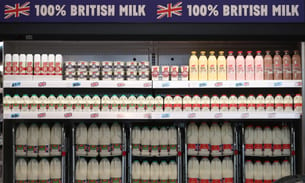
Our findings this time show that the number of factory dairies has doubled over the past decade. The investigation was published at a time when MPs have expressed deep concern over the exploitation of dairy farmers by processors and retailers. On supermarket shelves, milk is sold for much less than what it costs to produce it, while the cost of feed, fuel and fertiliser is going up.
My reporting found that the economic pressures facing farmers are intrinsically linked to the spread of intensive dairy farming. That may be why there was much more interest in our latest investigation than previous similar stories.
Since we published, several well-placed industry sources got in touch to say that our figures were “way off” – that the true number is far higher. They couldn’t put a figure on it either, but were confident many farms remain unaccounted for.
That uncertainty is frustrating – but as one of our sources said, an “undercount” is a good problem to have (certainly better than an “overcount” which, as a journalist, would be a big headache indeed).
Header image: a milking station in a dairy farm. Credit: Nigel Akehurst
Reporter: Andrew Wasley
Production editor: Sasha Baker
Deputy Editor: Chrissie Giles
The Bureau has a number of funders, a full list of which can be found here. None of our funders have any influence over editorial decisions or output.
-
Subject:
-
Area: