How Westminster rolled out the red carpet for crypto’s savviest CEO
Coinbase has been cosying up to the ministers and mandarins behind the UK’s upcoming crypto policy – and is already reaping the rewards
At Davos in early 2025, Varun Chandra – Keir Starmer’s chief business adviser – sat down with Brian Armstrong, the billionaire CEO of crypto giant Coinbase.
The meeting was just the start of a newly aggressive lobbying drive by the company targeting the highest levels of the British establishment, according to briefing documents and data we’ve obtained.
Last year, Coinbase – the US’s largest crypto exchange, where customers can trade and store digital currencies like Bitcoin and Tether – attended more meetings with ministers than any other crypto company. It has also hired political heavyweights including the former chancellor George Osborne, cultivated a “grassroots” campaign group, and secured access to senior figures across Downing Street and the Treasury – just as the UK prepares sweeping new rules for digital assets.
While some people view cryptocurrencies as the preserve of speculators, the companies underpinning the sector are becoming financial giants with the resources to influence politics and the rules governing the future of money.
Ministers have moved to ban cryptocurrency donations to political parties because of transparency concerns. Meanwhile huge donations from those who have made fortunes in the crypto business – most notably to Nigel Farage and Reform UK – have indicated the industry’s growing political clout.
At the same time, the Bank of England has been preparing for digital currencies to become part of everyday payments, meaning the rules laid down now have massive implications for the whole financial system. The Bank wants to limit risk; Coinbase wants to maximise profit.
Coinbase’s access to the corridors of power comes despite the fact its UK subsidiary remains the only crypto business to be fined by the Financial Conduct Authority (FCA) for repeatedly breaching restrictions around taking on high-risk customers. Coinbase later reported some of these customers for suspected money laundering, fraud and the sale of stolen credit-card information.
The company wants to repeat in Westminster what the crypto industry managed in Washington, where hundreds of millions of dollars in political spending, lobbying and funding of grassroots campaigns have helped secure the most crypto-friendly administration in US history. A month after Donald Trump returned to the White House, a case against Coinbase was dropped by the Securities and Exchange Commission. (Coinbase said the case “should never have been filed in the first place”, accusing the previous SEC leadership of waging a “war against crypto”.)
And its UK lobbying already appears to be paying dividends: last week the Bank of England announced three major concessions to the crypto industry.
Coinbase told us it is transparent about its “engagement with policymakers” and said the government’s “actions to support investment and innovation, while establishing the right regulatory framework, are impressive”.

Corridors of power
Five months after the Davos dinner, Armstrong would find doors opening across Whitehall.
Armstrong had only eight hours in London on 16 June last year. But he made those hours count: in less than a day, he had a face-to-face meeting with Andrew Bailey, the governor of the Bank of England, and another at 10 Downing Street with Chandra and Jonathan Reynolds, the then business secretary. (He was also scheduled to meet the FCA, but it says it didn’t happen.)
We don’t know what Reynolds and Chandra discussed at No 10, but briefing notes we obtained via Freedom of Information requests reveal the issues that officials expected Armstrong would raise – and the government’s position.
Armstrong would want a clear commitment to crypto’s future in the UK: a government “action plan” for crypto to mirror the one for artificial intelligence, released in January 2025. The plan should focus on “opportunities that [blockchain technology] might afford, rather than the risks”, according to the briefing.
He was expected to argue that blockchain – the digital infrastructure on which cryptocurrencies depend – should be integrated into core government services such as “identity verification, benefits distribution and public procurement”.
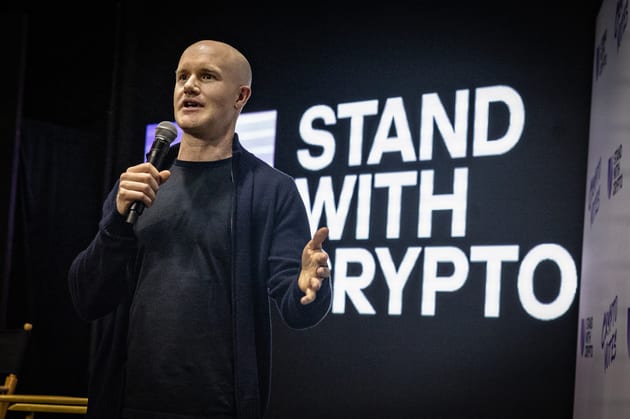 Coinbase CEO Brian Armstrong at a crypto industry rally in 2024
Jason Armond / Los Angeles Times via Getty
Coinbase CEO Brian Armstrong at a crypto industry rally in 2024
Jason Armond / Los Angeles Times via Getty
The UK should “accelerate the pace” on crypto regulation, the briefing notes suggest, adding that “financial centres that adapt early will gain significant market share”. It cited research from a digital media company saying that none of the crypto and blockchain companies worth more than $1bn – there were 90 of them at the time – is based in the UK.
Officials expected Armstrong to argue that if the UK failed to allow crypto versions of the pound, businesses and investors would increasingly favour dollar-backed alternatives. This, the argument went, could weaken sterling’s position in global finance and send the cost of servicing the UK’s vast debt soaring.
Reynolds, for his part, was urged to reiterate the government’s commitment to become a “leading destination” for digital assets. Officials told him to stress that the UK government, while drawing up new rules for the crypto industry, was listening carefully to its concerns.
As far as Armstrong’s meeting with the Bank of England that day goes, the details remain cloaked in secrecy. The Bank confirmed Armstrong met the governor and Sarah Breeden, one of the deputy governors, at Threadneedle Street, but refused to disclose any specifics, citing an exemption to Freedom of Information laws relating to “information provided in confidence”.
‘Money moves the needle’
Armstrong’s visit to No 10 was just one part of a wider lobbying effort.
The company attended 10 meetings with ministers in 2025 alone, the most of any year in its history. Of Coinbase’s 31 meetings with ministers since 2014, 28 have taken place since the start of 2022.
It has held or attended far more meetings with ministers than its competitors in the last decade, and is the only firm to have met a serving prime minister.
Coinbase has also funded an all-party parliamentary group (APPG), on Digital Markets and Digital Money, via a consultancy firm. It supports a growing ecosystem of organisations and “forums” designed to bring politicians and crypto execs closer together.
The company maintains extremely close ties to Stand With Crypto, a “grassroots” movement with almost 300,000 members in the UK. It was launched by, and now “partners” with, Coinbase. The group has submitted its own evidence to parliament on digital asset policy, independently of its powerful backer.
Key players have moved seamlessly between the company and the group. In the UK, Stand With Crypto is controlled by Smrthi Sathe, Coinbase’s former head of community engagement. Nick Carr, the group’s chief strategist, later switched to Coinbase.



The links extend beyond staff. When the group staged an event in Westminster, parliamentary records show the room was booked by Coinbase. Stand With Crypto’s privacy policy states that it can share personal information with the company, and vice-versa. Coinbase told us this was standard privacy practice and not an unusual data-sharing arrangement.
Financial filings also underline the relationship. The US-based Stand With Crypto Alliance reported holding cryptocurrency worth almost $600,000 on the Coinbase exchange.
While the British operation remains modest, Stand With Crypto’s US group spent almost $19m in 2024.
That campaign has operated alongside an even larger US political spending machine. Coinbase has contributed roughly $94m to Fairshake, the crypto industry’s powerful political action committee, helping to fund a huge wave of corporate election spending for crypto-friendly candidates in both parties.
Public Citizen, a consumer advocacy group, described the flow of crypto money into American politics as “a brazen and unprecedented attempt by for-profit businesses to force their private, pecuniary priorities ahead of the public interest”.
Armstrong himself has been unusually candid about his motives. “Money moves the needle,” he told Axios. “For better or worse, that’s how our system works.”
In a statement, Coinbase told us that “Stand With Crypto currently represents the voices of 290,000 crypto supporters in the UK” but did not respond to questions about the ties between the two.
Stand With Crypto’s international director Adriana Ennab told us the group is a global movement with more than 3 million advocates worldwide.
“In the UK, Stand with Crypto has been supported by Coinbase, which remains an important partner,” she added. “Today, we work with our 30+ partners in the UK, including founders, investors, universities and major players across the digital asset ecosystem, to help drive a pro-innovation environment for consumers, builders and businesses.”
Changing tides?
It’s a crucial moment for crypto in the UK, as the FCA and Bank of England will publish new rules for the industry later this year. The regulations pave the way for a new digital version of the pound – as Coinbase called for – which the Bank believes will be widely used in years to come.
While cryptoassets barely featured in Labour’s manifesto in 2024, the industry has received an unexpectedly warm embrace from Rachel Reeves, who as chancellor is struggling to deliver the growth she promised on the campaign trail.
A month after Armstrong’s schmoozing in No 10, Reeves made bold, if vague, promises on the potential of cryptoassets for the UK in a speech at Mansion House.
Speaking fluent cryptobro, she announced the country was “driving forward developments in blockchain technology, including tokenised securities and stablecoins, and an ambitious design for a new digital gilt instrument, so that UK financial services can be at the forefront of digital asset innovation”. She later announced a transatlantic crypto taskforce with the US.
The Bank of England has also changed its tune on crypto: last week it announced updates to its proposed digital currency regulations – including three major concessions to the crypto lobby.
Cryptocurrency brings huge risks – from massive dirty money flows to serious environmental costs and major financial instability
It has dropped plans to cap the amount that can be held in the new currencies. It is increasing the amounts crypto firms can invest in interest-bearing accounts. And while the Bank continues to oppose crypto firms offering interest to customers, it will let coinholders receive other types of rewards.
A spokesperson for the Bank said it had acted transparently, adding its draft rules came following “several discussion papers and consultations” and it has “published summaries of the feedback received and how it has informed our thinking”. They said: “We expect to finalise the regime by the end of the year.”
Susan Hawley, the executive director of transparency campaigners Spotlight on Corruption, said that the activity revealed by our reporting was “a great example of how the US firms are really investing a lot of time and resources to try and influence the UK” and push for similar concessions to those secured in the US.
She warned there was a risk government policy was “being steered by those who would massively profit from a lax regime”.
“Mainstreaming cryptocurrency into our financial system brings huge risks – from massive dirty money flows to serious environmental costs and major financial instability,” she added.
A government spokesperson declined to answer our questions about the safeguards in place to prevent crypto lobbying influencing policy.
“Cryptoassets in the UK have to date been largely unregulated, which scammers and fraudsters can exploit,” the spokesman said. “That’s why in December last year we announced new legislation to regulate cryptocurrency firms.”
A Downing Street spokesperson told us that meetings like the one Chandra had with Armstrong are “a core and entirely expected part of the business adviser’s role”.
Crypto concerns
While doors have been flung open to crypto, the government is clearly aware of the substantial risks the industry brings.
The UK’s Illicit Finance Summit, a global conference to stamp out dirty money now planned for December, named crypto as one of its key focuses. In 2025, the government said cryptocoins were a significant and growing risk for money laundering and funnelling money to terrorists.
Coinbase is no stranger to scrutiny, having received a £3.5m penalty in July 2024 from the FCA for taking on high-risk customers – more than 13,000 – while a restriction against doing so was in place. At the time, Coinbase said it welcomed regulation and wanted to “ensure we offer the most compliant, trusted, and secure platform for our customers”.
An FCA spokesperson declined to respond to questions about why it had cancelled its planned meeting with Coinbase and whether it had spoken to the firm on other occasions, but said: “We engage widely with firms, consumer groups and other stakeholders as we develop policy, and we consult publicly on our proposals. Meeting with firms is a routine and necessary part of our work.”
As well as being fined in the UK, Coinbase has also had ads banned by the UK’s advertising watchdog for “trivialising the risks associated with cryptocurrency investment”. The campaign portrayed Britain as a rat-infested, rubbish-strewn country suffering soaring prices and stagnant wages before suggesting cryptocurrency could offer a way out. Coinbase accepted the ruling but rejected the view that the ad was offering “any solutions”.
Coinbase’s intensive lobbying in the US has also caused friction with the traditional banking sector. According to the Wall Street Journal, in January, Armstrong was back at Davos and chatting over coffee with Tony Blair when JP Morgan’s CEO Jamie Dimon approached, pointed a finger in his face, and declared: “You’re full of shit.”
Luckily for Armstrong, his reception has been warmer in Washington and Westminster.
Reporter: Lawrence Marzouk
Additional reporting: Sara Farolfi
Production editor: Frankie Goodway
Fact checker: Alex Hess
Deputy editor: Chrissie Giles
Header image: Frankie Goodway / The Bureau
The Bureau has a number of funders, a full list of which can be found here. None of our funders have any influence over editorial decisions or output.
-
Area:
-
Subject: