How we showcased the human cost of offshore secrecy
Reporting on offshore secrecy throws up a constant challenge: who are the victims? So we set out to find them – and give their voices a platform
Beneficial owner. Family trust. Corporate registry.
These terms are familiar to financial journalists, but we can forget how meaningless they are to most people.
The issue of offshore financial secrecy feels distant from the issues of ordinary life: noisy neighbours, important hospital appointments, remembering whether it’s black-bin or green-bin week. And yet we know at the Bureau that the unexciting act of paperwork being shuffled through an anonymous company on a small island can in fact have a profound impact on people living thousands of miles away.
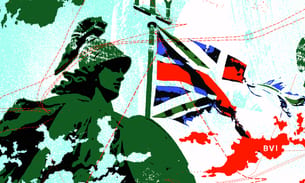
We have spent years investigating the role played by Britain’s Crown Dependencies and Overseas Territories – places such as Guernsey, Jersey, the Isle of Man and the British Virgin Islands – in facilitating financial secrecy. Again and again, we’ve found the same pattern: real-life harm being hidden behind shell companies, trusts and bewildering ownership structures.
The challenge for us is not simply reporting on the issue, it’s making people care about it. And so editors ask the same question whenever a story is pitched: who is the victim?
That was the inspiration behind Voices for Transparency: a photography exhibition that would showcase the plight of those whose lives have been harmed by offshore secrecy.
Finding the victims
At first glance, there’s no common link between a German journalist targeted by deepfake pornography, a survivor of a port explosion in Beirut and a Scottish woman defrauded of her inheritance.
We found these people by working with partners including Transparency International, OCCRP and Lighthouse Reports, which are all non-profit groups investigating corruption, to put together a list of potential photo subjects: people whose stories illustrated the human cost of remote financial operations.
Identifying the subjects was just the beginning. Next we had to persuade them to talk publicly again. Some were still dealing with financial loss, reputational attacks or legal battles from having already spoken out.
And once they had opted in, we had to translate our reporting into quality photography. This was far more complicated than simply commissioning good photographers. We wanted to capture the people and places where these stories had actually unfolded rather than impose a more detached, “journalistic” aesthetic. So where possible, we hired photographers from the same countries as their subjects.

We also made sure the photographers were given the proper context: the legal stakes, the reporting history, the emotional reality sitting the reams of disclosure records and reporting notes.
Most of the photographers were keen to take on the challenge; one considered rearranging his honeymoon around it. Another told me that “connection matters more than convenience”. That stayed with me – and it became something of an organising principle for the exhibition.
For the venue, we got in touch with the church of St Katharine Cree. Set amid the skyscrapers of the City of London, it has long served as a gathering place for people attempting to build a fairer version of the world surrounding it.
Slowly, the project was moving from spreadsheets and phone calls into something tangibly real.
On display
The last days before launch were consumed by the less glamorous realities of investigative journalism: right-of-reply emails.
All our portraits would be accompanied by captions explaining the subject’s story. And although many had already been reported, this still meant putting the allegations to the people in question.
 Katia Pirnak / TBIJ
Given the nature of many of these companies, simply tracking down the right people to contact was an investigative exercise in itself. Some clearly did not want to be found.
At one stage, our search for the respondent for a shifting network of companies sent us bouncing between Liechtenstein, Malta and the British Virgin Islands. Then, not long before installation, another email arrived. This one came from Lithuania, claiming we had failed in our duty as journalists to contact the right person for comment.
By this point the photographs had already been printed. And we found ourselves trawling over old files, archived webpages and business registries to ensure we hadn’t missed something vital.
We hadn’t, and the exhibition opened on time. But the episode felt strangely clarifying.
Even for an investigative newsroom, trying to find out the basic details behind some of these companies can be a stressful, time-consuming and frequently absurd task. For those without our resources, it is basically impossible.
People like Sam Byrne, who watched Thurrock council slide towards financial ruin through disastrous investments linked to a businessman who moved money through the Isle of Man. Or Caroline Howard, who struggled during Covid to get hold of PPE equipment while companies supplying defective gowns generated millions in profits that were passed offshore. Or Ruth Low, who had serious safety complaints about the building she lived in but was unable to identify or contact the owner: a company registered in Guernsey.
 Sam Byrne
Photo: Alex Kurunis
Sam Byrne
Photo: Alex Kurunis
 Caroline Howard
Photo: Frankie Mills
Caroline Howard
Photo: Frankie Mills
All of these people had their portraits displayed in the church when the exhibition opened earlier this month. And there was something unexpectedly powerful about watching audiences encounter investigative reporting in physical form. At the exhibition, people lingered over stories they might otherwise have scrolled past online in seconds.
Jen McAdam, another of our subjects, lost her inheritance after investing in OneCoin, the multibillion-dollar cryptocurrency scheme later exposed as a fraud. By the time we spoke to her, she had spent years campaigning on behalf of victims in the face of huge legal hurdles.
Seeing the portraits for the first time, she said they captured something the reporting alone could not.
“It struck an emotional chord within that led me to reflect there and then on this long and hellish journey for victims' justice,” she said.
“The images evoked in me such profound feelings of pain, suffering and an unwavering determination to continue the fight. Personally, there is nothing that has ever felt warm in this story, cold and cruel, and the black and white image to me personally feels that all has been captured in that one image. Incredible.
“I have never experienced such a powerful connection to a photograph before.”
On June 17, the Voices for Transparency exhibition moves to the Houses of Parliament.
Lead image: Katia Pirnak / TBIJ
Reporter: Elle Zahrouni
Enablers editor: Lawrence Marzouk
Deputy editor: Chrissie Giles
Editor: Franz Wild
Production editor: Alex Hess
TBIJ has a number of funders, a full list of which can be found here. None of our funders have any influence over editorial decisions or output.
-
Area:
-
Subject: