McDonald’s chicken supplier back in the spotlight for excessive water use
Environment Agency records show a chicken factory took more water than allowed two years running
.
Avara Foods is no stranger to controversy. The chicken company, which is joint-owned by the global agriculture giant Cargill and supplies meat to Tesco, Nando’s and McDonald’s, is already facing legal action over its alleged role in polluting Britain’s waterways.
Earlier this year, the law firm Leigh Day took the company to court on behalf of Wye Valley residents. They allege that the river they enjoy for recreation has been contaminated by toxic run-off from nearby farmland that had been spread with hundreds of thousands of tonnes of manure.
But now Avara’s use of water is in the spotlight. The company’s factories are licensed to take a certain amount of water from the ground for use in their operations. But one factory in Gloucestershire, according to Environment Agency records seen by the Bureau of Investigative Journalism (TBIJ), has exceeded those limits twice in five years.
Meanwhile, a separate Avara abattoir in Hereford has been noted by officials as a major consumer of water in an area where supplies are diminishing.


James Wallace, chief executive of the campaign group River Action, called for an urgent investigation into Avara’s water usage. “Having spent years poisoning the River Wye with nutrients from supplier chicken factory farms, it is shocking to see that Avara is also threatening water security for residents and businesses,” he said.
Celine O’Donovan, a solicitor at Leigh Day, told TBIJ that the allegations need to be considered in the context of the lawsuit, saying: “More than 4,000 people are demanding that the cost of industrial production must not be borne by their environment and the families and small businesses that make up their community.”
“We all want a healthy River Wye,” Avara told TBIJ, adding that the legal claim is based on a misunderstanding. It said no manure is stored or spread on poultry-only farms that supply Avara Foods and that individual farmers are responsible for how they use nutrients. It said it produces poultry in Britain to standards that are among the highest in the world.
Working sustainably?
The removal of water from natural sources for human use – known as water abstraction – is essential to meet the needs of industry and agriculture. But if it’s done excessively, it can dry up water sources and destroy biodiversity.
To ensure the process stays sustainable, the Environment Agency issues licences to thousands of businesses, farms and slaughterhouses, which stipulate when and how much water they can take.
 Pollution in the River Wye
Darren Staples / AFP via Getty Images
Pollution in the River Wye
Darren Staples / AFP via Getty Images
Avara, which was created in 2018 as a joint venture between Cargill and the UK company Faccenda Foods, processes around 4 million chickens a week. Poultry processing on this scale requires huge volumes of water to wash carcasses, remove internal organs and hose down factory floors.
Until 2024, a processing plant in Gloucestershire owned by Freemans of Newent, an Avara subsidiary, was licensed to extract water from boreholes within the Severn Vale river catchment. According to its licence, the company was allowed to extract a maximum of 125,000 cubic metres of groundwater a year for processing purposes.
But the firm took more than this for two years running. In total, it took about 7,000 cubic metres more than it was allowed to – almost enough to fill three Olympic swimming pools.
“Avara have been expanding and intensifying their chicken production in Herefordshire over the last decade or two without considering the consequences for local environments and communities,” said Alison Caffyn, a campaigner and expert on the poultry sector.
“Both the poultry units and the processing plants use large volumes of water so not only does the industry pollute the rivers with poultry waste, but also harms river health.”
A spokesperson for Avara told us: “Water is essential to clean our products and facilities, to make sure that we meet food safety and quality standards.”
Water abstraction at the Gloucestershire factory ceased in 2024, records show, after its primary processing operations were switched to other Avara sites.
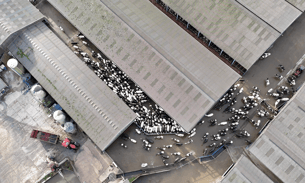
 Avara’s processing plant in Hereford, which takes water from the nearby Wye Valley.
Darren Staples / AFP via Getty Images
Avara’s processing plant in Hereford, which takes water from the nearby Wye Valley.
Darren Staples / AFP via Getty Images
A separate Environment Agency document seen by TBIJ shows that in 2023 inspectors found Avara’s water use at the nearby Hereford slaughterhouse had increased year on year. An official wrote that the company should continue focusing on reduction. However, they also noted that increased usage in 2023 was related to avian flu.
A number of boreholes were licensed to extract groundwater at the Hereford plant, sourcing from the River Wye catchment – which according to the Environment Agency website does not always have enough water to meet abstractors’ demands.
The Environment Agency document, part of an annual review of Avara’s Hereford processing plant, reported that more than 230,000 tonnes of poultry meat had been produced at the plant that year, using nearly a million cubic metres of water.
To address the issue, a “strategic discussion” about the company's water efficiency was held in April 2024 between company executives, Environment Agency officials and representatives of the industry body Water Resources West.
The meeting’s summary, which described Avara as a “significant” abstractor of water, noted that the company needed to make a sequence of “business-critical” decisions to secure supply in the future.
Avara said it convened the meeting as part of its ongoing commitment to proactively manage and reduce water consumption. It stressed that water abstraction at the Hereford site, which is taken from groundwater, not rivers, is comfortably below the water abstraction limit that is set and subject to regular review by the Environment Agency.
The Environment Agency says that sustainable abstraction is essential to keep rivers flowing and promote ecology. According to the most recent official figures, approximately 10.4 billion cubic meters of water were directly abstracted from non-tidal surface waters and groundwater sources in England in 2018. It did not comment on Avara’s water use.
The agency responded to the growing problem in 2022 by introducing a new system of charges for major abstractors. However, according to Wildfish, which campaigns for sustainable habitats for fish, nearly a quarter of English rivers remain at serious risk from unsustainable water abstraction.
Tesco, Nando’s and McDonald’s did not respond to our requests for comment. The Department for Environment, Food & Rural Affairs said it was not currently able to comment.
The Environment Agency told us: “We’re committed to ending damaging abstraction of water from rivers and groundwater and we make full use of our existing powers to do so.” This includes amending or revoking existing licences when abstraction is damaging the environment.
This article was updated on 3 December 2025 to include a statement from the Environment Agency that was received after publication.
Header photo: Jim Wood / SOPA Images / LightRocket via Getty Images
Reporter: Andrew Wasley
Environment editor: Rob Soutar
Deputy editor: Chrissie Giles
Impact producer: Grace Murray
Editor: Franz Wild
Production editor: Sasha Baker
Fact checker: Alex Hess
TBIJ has a number of funders, a full list of which can be found here. None of our funders have any influence over editorial decisions or output.
-
Subject:
-
Area: